
Understanding the Ecosystem: What Every Changemaker Should Know
Welcome to iiCare's Nonprofit Education Series - a three-part breakdown designed to help you navigate the complex world of nonprofit structures and giving strategies. Whether you're a future founder, a funder, or a curious partner, we’re here to make this world easier to understand.
If you’re exploring how to start a nonprofit or deepen your understanding of charitable structures, one of the most important distinctions to understand is the difference between a public charity and a private foundation. Though both are tax-exempt 501(c)(3) organizations recognized by the IRS, their structure, purpose, and compliance requirements are very different.
At iiCare, we operate as a public charity—built to serve the public, funded by broad support, and committed to direct community programming. Here’s a breakdown to help you understand which structure might be right for you—or how to better engage with nonprofits in either category.
When starting a 501(c)(3) organization, the IRS generally classifies the nonprofit as a private foundation by default—unless the applicant can demonstrate why it should be classified as a public charity instead.
All 501(c)(3)s must meet these general criteria:
There’s also a lesser-known third category: private operating foundations. These hybrids mix the governance model of private foundations with the direct service delivery typical of public charities. However, they are uncommon and suited for unique situations.
A public charity is the most common type of 501(c)(3) organization. According to the IRS, more than 72% of active nonprofits fall into this category.
As a fiscally sponsored initiative of the Social Impact Fund (SIF), iiCare benefits from full nonprofit compliance while operating as a public charity. We:
Private foundations make up a smaller percentage of 501(c)(3) nonprofits but often command large financial resources. These organizations are created to make grants to other charities rather than operate programs themselves.
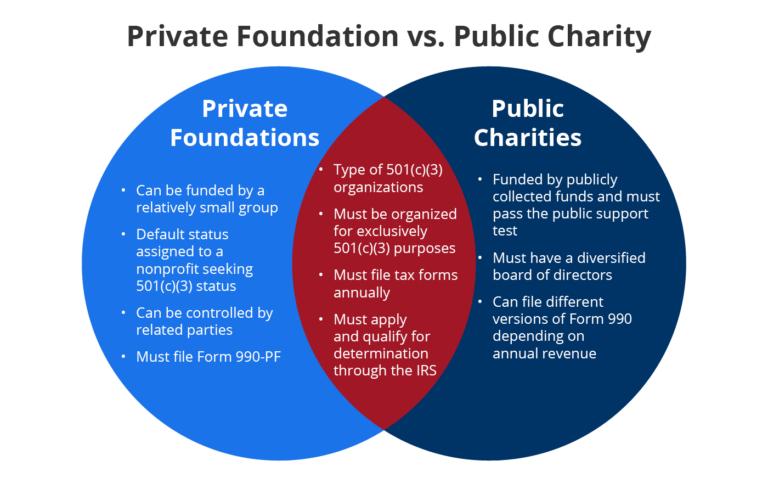
There is no universal answer—your decision depends on the mission, funding model, and level of public involvement you want.
At iiCare, public charity status aligns with our community-driven mission. It allows us to:
We believe real change happens at the grassroots level—so our structure reflects that.
Whether you support a public charity or create a private foundation, both models can drive meaningful impact. What matters most is mission alignment, transparency, and the communities you intend to serve.
At iiCare, we operate with the public at the center of our purpose—and with a structure that makes sure every donated dollar leads to measurable opportunity.
Want to learn more or partner with us? Visit our contact page and let’s build something meaningful together.


Lorem ipsum dolor sit amet, consectetur adipiscing elit. Suspendisse varius enim in eros elementum tristique. Duis cursus, mi quis viverra ornare, eros dolor interdum nulla, ut commodo diam libero vitae erat. Aenean faucibus nibh et justo cursus id rutrum lorem imperdiet. Nunc ut sem vitae risus tristique posuere.
.png)